Home › Sitework and Structural Concrete
Superior Concrete Pittsburgh provides sitework and structural concrete services for commercial projects across Pittsburgh, PA. We construct footings, walls, piers, and equipment pads that support buildings and heavy machinery. Our team coordinates layout, excavation, rebar, and pours to meet engineering requirements and keep your schedule moving.
Superior Concrete Pittsburgh provides professional structural concrete throughout Pittsburgh, PA, Pennsylvania and the surrounding area. Our licensed, insured crew delivers safe, clean, on-time work with a free estimate before anything begins. Call (412) 223-8423 or request your free quote.
Sitework and Structural Concrete for Pittsburgh Projects
Superior Concrete Pittsburgh provides full sitework and structural concrete services for commercial, industrial, and residential projects across Pittsburgh and the surrounding Allegheny County area. We focus on the concrete elements that carry load and keep a structure stable, such as footings, foundations, slabs, grade beams, and structural walls, along with the grading and preparation that make those elements perform for decades.
In this region, projects have to deal with hills, mixed soil profiles, and freeze thaw cycles. Our crews are used to working on tight city lots in Lawrenceville, steep driveways in Mount Washington, and larger commercial sites in Monroeville and Cranberry. That local experience shapes how we evaluate bearing capacity, drainage paths, and frost depth so your structural concrete is sized correctly and supported properly from day one.
How We Approach Sitework Before Concrete Is Placed
Every structural concrete project starts with controlled sitework. We clear vegetation, strip topsoil, and remove organic or unstable material until we reach competent subgrade. On Pittsburgh hillsides this can mean bench cutting into slopes and building compacted fills in lifts to create a stable platform, instead of just piling soil and hoping it holds.
We perform rough grading to establish the correct elevations relative to property lines, utilities, and existing structures. Where plans call for specific slopes, such as 2 percent away from a building or specific pitch to storm inlets, our operators set up laser levels to maintain those numbers across the entire pad.
Subgrade compaction is verified with plate tampers or rollers, and on higher load areas like warehouse slabs or dumpster pads we often specify a compacted crushed limestone base. In older Pittsburgh neighborhoods with fill material of unknown origin, we may recommend undercutting and replacing certain areas to avoid future settlement that can crack structural concrete.
Drainage is addressed before any concrete goes in. This can involve installing underdrains behind retaining walls, daylighting perimeter drains on walkout basements, or shaping swales to move roof runoff away from foundations. Dealing with water at the sitework stage prevents hydrostatic pressure from undermining your structural concrete later.
Foundations, Footings, and Structural Walls
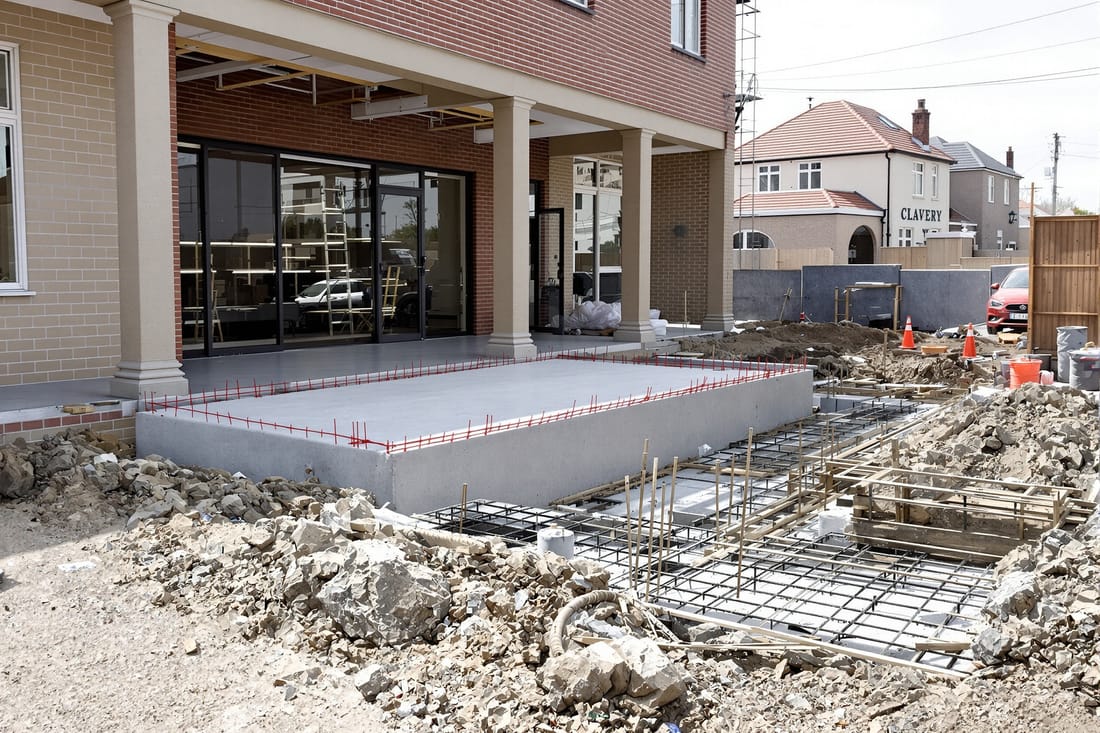
For foundations and structural walls, we tie the sitework directly to the structural design. Footings are laid out to match the engineer's plans and then double checked on site so that column lines, wall locations, and step downs align with real ground conditions. In sloped parts of Pittsburgh it is common to use stepped footings to keep the bottom of footing below frost depth while following the grade, rather than over excavating unnecessarily.
We build and brace forms to hold the correct size and elevation of each footing or wall, then place reinforcing steel according to the design. This includes dowels for future slabs, hooks and laps at corners, and extra steel at reentrant corners where cracking is most likely. In basements, we coordinate openings for windows, doors, and mechanical penetrations so they are cast exactly where the other trades expect them.
Concrete for foundations is typically a higher strength mix, commonly 3,500 to 4,000 psi in this area, with air entrainment for freeze thaw resistance. For retaining walls or heavily loaded columns, we may recommend even higher strengths or supplementary cementitious materials that improve durability. Our crews use internal vibrators during placement to consolidate the mix, especially in congested rebar areas, which greatly reduces honeycombing and voids in structural concrete.
Once stripped, we check wall plumbness and footing elevations so that framing or steel erection starts on a precise base. Any minor surface defects are addressed immediately with patching compounds designed for structural applications, not cosmetic fillers.
Structural Slabs, Reinforcement, and Control of Cracking
Structural concrete slabs, whether on grade or elevated, are built to handle the specific loads and use of the space. For garages, warehouses, and loading areas, we pay close attention to subbase thickness, compaction, and vapor barriers. On residential projects we may use welded wire mesh or rebar grids, while for commercial slabs we often install deformed rebar or post installed dowels at column lines and joint locations.
In Pittsburgh's climate, controlling cracking is about design and execution, not promising a crack free slab. We use a combination of proper joint spacing, steel reinforcement, and curing practices to manage where cracks form and how wide they become. For example, on a 4 inch thick residential garage slab, control joints are typically cut at panels no larger than 10 feet by 10 feet. On thicker commercial slabs, spacing may increase, but layout must consider column locations and door openings to avoid random cracking.
We commonly place 4,000 psi air entrained mixes for exterior slabs and aprons to handle freeze thaw and deicing salts. Interior slabs may use non air entrained mixes for a tighter finish, especially under epoxy or polished systems. Our finishers adjust timing based on temperature and humidity, so troweling does not seal bleed water into the surface, which can lead to scaling in winter.
For elevated structural slabs, we coordinate with engineers and steel erectors on formwork, shoring, and rebar placement. Lap lengths, bar sizes, and stirrup spacing are followed precisely. We check camber and deflection tolerances before placing concrete so finished floors come out level within project requirements.
Materials, Mix Designs, and Local Conditions
Structural concrete in Pittsburgh must handle freeze thaw cycling, chloride exposure from winter road salts, and, in some cases, older neighboring structures that move differently than new work. Superior Concrete Pittsburgh works with local ready mix suppliers to select mix designs tailored to these conditions instead of using a one size fits all recipe.
Key variables include compressive strength, water cement ratio, air content, aggregate size, and admixtures. For exterior structural slabs and decks, air entrainment and a low water cement ratio are critical to reduce surface scaling and internal damage from freezing moisture. For heavily reinforced walls and beams, we may shift to smaller aggregate to improve consolidation around dense rebar cages.
Set time is also adjusted seasonally. In cold months, accelerators and heated water help maintain workable schedules without over finishing cold surfaces. In summer, retarders keep the concrete plastic long enough for proper placement and finishing even on larger pours. These choices directly affect performance and cost, which is why we review mix design options with project teams before pours begin.
On projects close to rivers or in low lying areas such as parts of the Strip District or the Flats, we often address higher groundwater by combining mix design choices with waterproofing details, such as integral crystalline admixtures in foundation walls or denser mixes at elevator pits.
What Drives Cost and Schedule for Sitework and Structural Concrete
Several factors influence pricing and timelines for sitework and structural concrete in Pittsburgh. Access is a major one. If concrete trucks cannot get close and we need to pump long distances or use smaller equipment in tight alleys, cost and time go up. Steep or confined sites require more labor for staging, bracing, and safety, especially in neighborhoods with very narrow streets.
Subsurface surprises are common in older parts of the city. Buried debris, undocumented utilities, or unsuitable fill can lead to undercuts and replacement stone or engineered fill. We mitigate these risks through preconstruction site walks, reviewing available geotechnical reports, and planning allowances where conditions are uncertain rather than hiding contingency in vague line items.
Structural complexity also plays a big role. Heavier rebar, thicker slabs, and intricate forming for curved or stepped walls all add labor and material. However, proper detailing can sometimes reduce costs, for example by combining grade beams with perimeter footings or using thickened slab edges in place of separate small footings where the design allows.
Schedule is set not just by how long concrete takes to place, but by curing requirements, formwork cycles, inspections, and coordination with other trades. We build realistic schedules that account for city inspections, weather windows during freeze thaw seasons, and the sequence of other work, such as underground utilities that must be installed before slabs are poured.
Why Local Structural Concrete Experience Matters
Structural concrete is not just about placing and finishing a slab or wall, it is about understanding how that structure will perform on this particular piece of Pittsburgh ground and in this specific climate. Superior Concrete Pittsburgh has worked on hillside homes, riverfront developments, downtown infill projects, and industrial slabs in former mill sites, each of which brings different challenges.
Local code knowledge is critical. We coordinate with Pittsburgh building officials on frost depth for footings, reinforcement requirements, and inspection points. We are familiar with the expectations of common local engineering firms, which helps avoid last minute changes in the field. Our team also understands how to phase work in busy neighborhoods to respect traffic patterns, neighbor access, and noise limitations.
Before you hire a contractor for sitework and structural concrete, ask how they handle drainage on sloped sites, how they verify compaction and subgrade stability, what mix designs they propose for your specific exposure conditions, and how they plan to control cracking. We are prepared to answer those questions in detail, backed by local project experience, so you can be confident that the concrete you do not see after the project is finished is just as solid as the finishes you look at every day.